
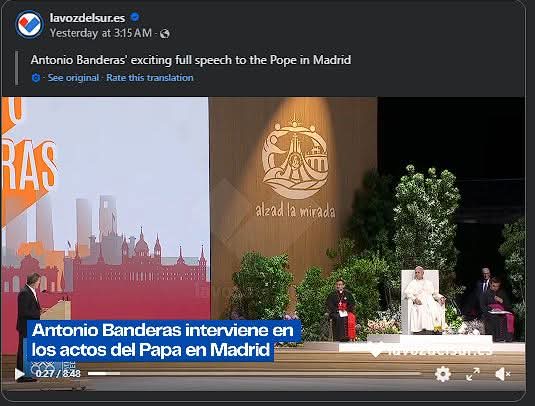
HOLY FATHER, distinguished authorities, dear friends:
There are encounters whose significance cannot be measured merely by the time they occupy, but by the meaning they carry. Your presence here today in Madrid, Holy Father, is not simply a visit; it is a gesture—a gesture of listening, of closeness, of dialogue with civil society. And for that, civil society is deeply grateful.
At times, such dialogue is best strengthened through a common language. That language is—and throughout history has often been—art.
The relationship between the Catholic Church and the arts has not merely been fruitful; it has been formative. We need not fear exaggeration when we say that the Church has been the greatest patron of art in the history of humanity.
At the heart of that creative impulse stands one figure who transcends centuries, styles, and cultures, and who has surely been the most depicted person in the history of art: Jesus Christ, the central figure in the drama of human life. Across every artistic medium, Christ appears as an icon of peace, love, and sacrifice, surrounded by an inexhaustible mystery.
I could devote these remarks simply to recalling the great artists whose works have magnified the message that springs from the words of Jesus. I could also limit myself to recounting the long and rich history of dialogue between the Church and artists, intellectuals, and philosophers. But today, Holy Father, I feel compelled to offer a brief personal reflection drawn from my own experience.
To do so, I must travel back in time to the Holy Week celebrations of my beloved Málaga in the 1960s. Those popular manifestations that transform the streets into a majestic ritual of art and faith, culture and devotion. It was there, Holy Father, amid that anonymous popular art, that a question was born within me when I was no more than four or five years old. It was a question consisting of a single word:
God.
Little by little, I began to discover answers.
Some were as simple as what I saw reflected in my mother’s eyes as she fixed her gaze—and her devout heart—upon the Virgin of Hope as she passed before us on her throne during those distant years.
Others came through the voices of the cantaores and cantaoras, whose saetas pierced the clear spring air.
Still others came through the humble and good people of my city who, year after year, take to the streets carrying their neighborhoods upon their shoulders, bearing the sacred images that help them search for themselves even as they search for God.
And they do so by leaving behind the self in order to embrace the we. From the we they move to them; from them to everyone; from everyone to the world; from the world to the universe; and from the universe to God.
And then they return to earth, sensing that God may dwell within every particle, every molecule, every drop of water, every sea, every rose petal, every heartbeat, every sigh.
But art is not only beauty.
Art is questioning. Art is reflection. Art is contrast. Art is revolution. Art is the tension between what we know and what we only intuit.
Art has been—and must continue to be—the mirror that reflects lives that pass by the wounded neighbor without stopping. It is also the denunciation of empty creeds that have forgotten love. It is a voice of warning to societies that have grown accustomed to injustice.
Art must be an alternative to violence—to every form of violence.
Just as Christ himself did, the artist must act with courage and must never abandon the responsibility of being a critical voice—toward society, toward art itself, and even toward religion itself.
Holy Father, we share a common obligation.
We are obliged to look, to see, and to seek to understand the complexities of the human soul. Every human being must confront the great questions of existence:
Who are we?
What meaning do life and suffering possess?
What does it truly mean to love our neighbor as ourselves?
What lies beyond?
Holy Father, in a world that races ever faster, that fragments itself, and that too often reduces reality to simplistic answers, art helps us recover depth. It helps us recover the soul—a soul that is increasingly at risk of being overshadowed by artificial intelligences, which must remain at the service of the human person and never the other way around.
It helps us recover that inner voice which whispers that there is something more.
The persistent whisper of hope in that “something more.”
We must continue to create and to share. We must continue to question and to seek. We must continue to pursue beauty, yes—but also truth.
For wherever we dare to ask profound questions, a journey begins. A journey that may lead us toward the spiritual.
And this is nothing other than the fraternity that beats within every human heart, just as it beats within the mysterious heart of God.
People say that these are bad times.
Let us be better, and the times will be better.
As Saint Augustine said:
“Times are bad, times are difficult, people say. Let us live well, and the times shall be good. We are the times: such as we are, such are the times.”
Holy Father, I am here because of Godspell.
Godspell is a musical theatre work created, composed, and first performed in your country. You know well that its title invites a beautiful play on words, as though one were living under God’s spell.
Today, Holy Father, I stand before you confessing that I have indeed fallen under God’s spell.
I have been captivated by God.
Thank you very much
(Madrid, Spain. 8 June 2026)


