

A post appears on a phone. A headline catches the eye. A message arrives from a friend, urgent enough to share before anyone asks where it came from.
In the time it takes to tap a screen, information can travel from one person to hundreds more. It can connect communities and bring important issues to light, but it can also spread falsehoods, expose private information, and harm people who may never know who started it.
For young Filipinos who spend much of their lives online, the space between seeing and sharing has become a test of judgement and responsibility. In these ordinary digital decisions lies an opportunity to protect others, uphold the truth, and help build a safer online community.
This was the message at the heart of Kilos Kabataan: Unite for a Digital Safe Future, which gathered around 50 students, including campus journalists, at the Bataan Peninsula State University (BPSU) Main Campus in Balanga City, Bataan, on October 14.
Now in its 9th season, the Philippine Information Agency (PIA) Region 3 program partnered with the Department of Information and Communications Technology (DICT) and BPSU to promote responsible internet and social media use.
Beyond discussions on misinformation and cybersecurity, the forum underscored a broader point: young people are not merely users of digital technology. Through their everyday choices, they can help shape the online spaces where people learn, communicate, and form opinions.
The weight of a single share
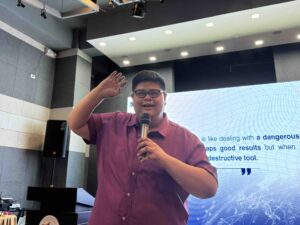
PIA Assistant Regional Head Carlo Lorenzo Datu reminded participants that social media has given ordinary Filipinos the power to become information providers, allowing their voices and ideas to reach wider audiences.
“Social media is an enabler for information dissemination. It empowered the Filipino or any netizen for that matter to become a provider of information,” he said.
That power, however, carries risks. Datu discussed misinformation, disinformation, and malinformation, along with the growing sophistication of fake news that can imitate legitimate news reports and exploit emotions to mislead readers.
Advances in artificial intelligence have further made it easier to produce convincing false content, reinforcing the need to examine information before accepting or sharing it.
The response begins with seemingly simple habits: checking the original source of a claim, looking for corroborating reports, and questioning posts that provoke an immediate emotional reaction.
These actions may take only a few moments, but they can help prevent misleading information from reaching another audience.
PIA Bataan Government Information Center Coordinator Rick Quiambao emphasized that the digital space is also an avenue for young people to contribute to nation-building.
“Because being digitally responsible is not just about knowing how to use technology; it is about knowing how to use it wisely, safely, and for the greater good,” he said.
Through Kilos Kabataan, PIA Region 3 seeks to encourage secondary and tertiary students, as well as out-of-school youth, to participate meaningfully in nation-building, promote good governance, and contribute to social transformation through volunteerism.
In the digital age, that participation can begin with refusing to spread an unverified claim, choosing credible sources, or helping others recognize misleading content.

Safety begins with everyday habits
Responsible online behavior extends beyond determining whether information is true. It also means protecting personal information and recognizing the risks that come with everyday internet use.
A suspicious link, a weak password, or an unsecured connection can expose users to threats they may not immediately recognize. For students who rely on digital platforms for schoolwork, communication, and personal interactions, knowing how to secure an account is as important as knowing how to evaluate the information they encounter.
DICT Bataan Provincial Focal for the ICT Literacy and Competency Development Bureau John Michael Bagara discussed these concerns in his presentation on cyber hygiene.
He explained that cyber threats include software vulnerabilities, malware, hacking attempts, and phishing scams, while limited awareness, human error, excessive trust in technology, unsecured networks, and poor security practices can leave users vulnerable.
Bagara encouraged students to use strong passwords and multifactor authentication, avoid suspicious links, check website security, and exercise caution when interacting with strangers online.
He described cyber hygiene as the regular checks and actions people take to keep their personal and public online spaces safe.
“Online safety is not just about tools. It’s about smart decisions. Cyber security is a shared responsibility—through digital bayanihan, it starts with you,” he said.
The idea of bayanihan offers a familiar way to understand digital responsibility. Protecting one’s own account is important, but helping others recognize online risks matters, too.
A student who spots a scam can warn a classmate, while someone who understands privacy settings can help friends secure their accounts. In this way, individual precautions can contribute to a more informed and secure online community.
BPSU Student Development Office Head Louis Balana, who represented university President Ruby Santos-Matibag, likewise urged students to be mindful of what they post, encounter, and believe online.
“Kaya be mindful. Be mindful of what you post, what you see online and of course how you process the information you read kasi hindi lahat ng nakikita natin online ay totoo at tama,” Balana said.
He stressed the importance of media and information literacy and critical thinking amid rapid technological developments and the overwhelming flow of information.
Knowing how to use a platform, he reminded students, is not enough; they must also learn to assess the information it presents and make sound decisions about what they share.

Turning awareness into action
For Justin Paul Punzalan, associate editor for external affairs of The Guilds, BPSU Main Campus’ student publication, digital literacy also carries a responsibility to society.
Delivering the students’ message of commitment, Punzalan thanked PIA Region 3 for giving young people an opportunity to learn, exchange ideas, and recognize their role in creating safer digital spaces.
As a student journalist, he emphasized the importance of distinguishing misinformation from disinformation, using the internet responsibly, protecting personal accounts, respecting privacy, and understanding one’s digital footprint.
Punzalan called on young people to translate what they had learned into action and help bring about lasting, positive change in their communities.
“Sapagkat ang kabataan ay hindi lamang tagagamit ng teknolohiya; tayo rin ay may mahalagang papel sa paghubog ng isang mas ligtas, mas mapanuri, at mas responsableng digital future,” he said.
His message echoed the purpose of Kilos Kabataan: to encourage young Filipinos to become active participants in shaping their communities, both online and offline.
The initiative supports broader government efforts to strengthen digital literacy and responsible civic participation, recognizing that an informed public is essential to good governance and nation-building.
A forum cannot eliminate every scam or prevent every falsehood from spreading. Its value lies in the choices participants carry beyond the event: strengthening a password, leaving a suspicious link unopened, checking a claim before sharing it, or helping a friend recognize a potential threat.
The digital world will continue to move at the speed of a tap. New messages will arrive, headlines will compete for attention, and claims will circulate before their accuracy becomes clear. In a space where sharing takes seconds but the consequences can last much longer, the decision to pause matters.
Before the next click, a young Filipino can choose to question rather than assume, verify rather than amplify, and protect rather than expose. These decisions may happen far from public view, but together they can help build a digital community grounded in truth, care, and responsibility.
For the youth reached by Kilos Kabataan, a safer digital future begins not with the promise of a risk-free internet, but with the willingness to make better choices, and to help others do the same. (CLJD/RPQ, PIA Region 3-Bataan)