OUR MASS on this first Sunday of September has been designated by the CBCP as “Creation in Christ” Sunday, or the “Sunday of Creation in Christ.”
Our readings could not have been more timely. Even now, after more than three weeks of heavy rains, several parts of Central Luzon remain under a state of calamity. Many towns are still submerged in deep floodwaters that refuse to recede. Many families who have sought refuge in schools as evacuation centers have found even those places under water.
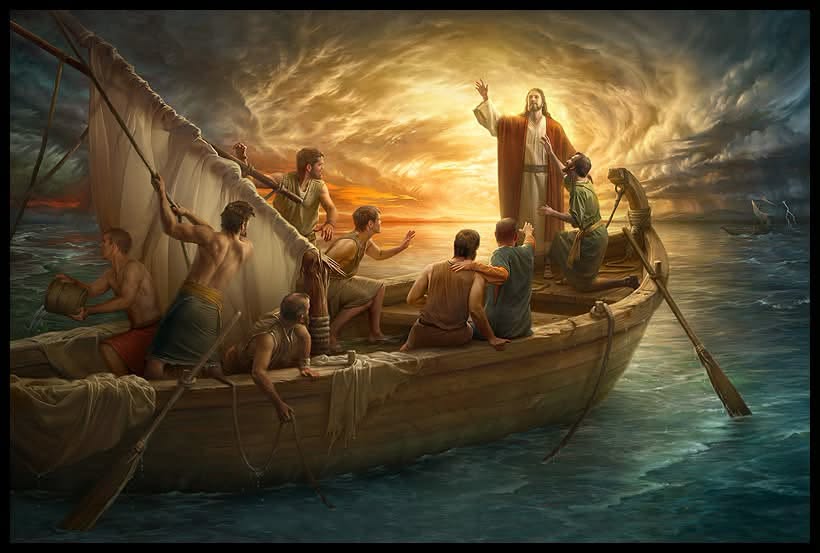
And so, we can easily relate to the situation of the disciples in today’s Gospel. They were in a boat with Jesus when suddenly a violent storm arose. The winds were strong, the waves were crashing against their boat—and Jesus was asleep. Terrified, they woke him and cried out, “Lord, save us! We are perishing!”
Jesus got up, rebuked the winds and the sea, and suddenly everything became calm. And the disciples asked one another, “What sort of man is this, that even the winds and the sea obey him?”
Our second reading, from St. Paul’s Letter to the Colossians, answers their question. Who is this person with them in the boat? St. Paul says: He is “the image of the invisible God, the firstborn of all creation. For in him all things were created, in heaven and on earth. All things were created through him and for him. And in him all things hold together.”
That is why this day is called not just the Feast of Creation but “Feast of Creation IN CHRIST.”
Some may ask why the CBCP chose to celebrate it on the first Sunday of September rather than on Tuesday, the first day of September itself. The answer is that the CBCP wanted precisely to emphasize the connection between creation and Christ. Every Sunday is centered on Christ. That is why even when patronal feasts are celebrated on Sundays, it is still the Sunday Mass that takes precedence.
Some of our fellow Christians in the Oriental tradition also celebrate the Feast of Creation as the beginning of creation, when God uttered his creative Word: “Let there be light.” It is a Word that brings into being what it speaks.
And so today we bring together the mysteries of creation and redemption, moving toward the new creation—the new creation inaugurated in the Resurrection of Christ.
Is this not also what St. John says in the opening words of his Gospel?
“In the beginning was the Word.
And the Word was with God, and the Word was God.
All things came into being through him.”
And then:
“The Word became flesh.”
This means that the Christ who is with the disciples, sleeping in the boat, is, for St. Matthew, the very Word of God. Through him the sea, the wind, the earth, and the whole of creation came into being. And so, when he spoke, the storm became still.

Let us now connect Matthew’s image of the boat with another boat in the Bible—the one in the Book of Genesis: Noah’s Ark.
When the great flood came, God instructed Noah to build an ark, a great boat. But it was not intended only for Noah and his family. It was also meant for the different kinds of animals entrusted to him for safekeeping.
I sometimes feel that something is missing from the story. I wish the author had also said that Noah was instructed to set aside a room in the ark for a collection of seeds from every kind of plant and tree. After all, how could the animals survive after the flood if there were no plants left?
The point is that Noah’s Ark was not simply a boat for the salvation of human beings. It carried within it the seeds of a new creation.
And Noah’s Ark is also a beautiful image of the Church. From ancient times, one of the favorite images of the Church has been the boat. But if the Church is a boat, whom does God want us to bring aboard?
If we are interested only in saving human beings, then ours is not Noah’s Ark. The mission of the Church cannot simply be about saving souls for heaven while allowing the earth to be destroyed. We must bring the whole of creation aboard with us.
God placed us in this world not to rule over it as absolute masters, but to care for it as stewards. Unfortunately, what has often been emphasized in the creation story is dominion—humanity’s power over nature: “Have dominion over all other creatures.”
But when dominion loses its sense of responsibility, dominion becomes domination. Care becomes abuse and exploitation.
And now we are seeing the consequences.
We cannot talk about flooding as though water alone were the problem. Flooding is, first of all, an ecological issue. What is happening to our mountains and forests? To our watersheds? To our rivers, streams, and wetlands? What has happened to the areas that once absorbed and stored water but have now been converted into subdivisions and new cities? What is the effect of climate change on the intensity and volume of rainfall?
What we need is a ridge-to-reef approach—from the mountains all the way to the sea.
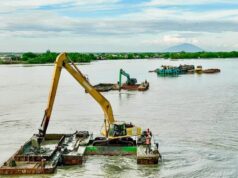
But it is also true that preventing floods is an engineering issue. We need dikes, drainage systems, pumping stations, dredging, and flood-control projects. Yet, as our present experience shows us, these will accomplish little if they are not part of a comprehensive master plan for our country’s eighteen major river basins.
And, of course, flooding cannot be separated from the issue of corruption. As Jessica Soho put it: “Perhaps it is not the flood that will sink our country, but greed.”
And so, at the deepest level, there is also a political issue—not politics in the service of the common good, but a politics of patronage.
The river cannot be expected to adjust to politics. Politics must adjust to science, engineering, ecology, and the common good. If every politician pursues his or her own projects according to personal political interests, then we should not be surprised that we spend billions upon billions on flood control while the flooding grows worse every year.
That is why the CBCP says that the ecological crisis has become a matter of “life and death,” especially for the poorest among us. What we need is not merely flood control. We need ecological conversion.
Brothers and sisters, is it not strange that despite the extraordinary heights human intelligence has reached, we still seem unable to truly progress?
We now have artificial intelligence. The human being created by God has himself created a technology that can help expand his own intelligence and creativity. We might call it “created creativity.”
But there is a problem. If AI can amplify our creativity, it can also amplify our addiction to power—and our capacity to destroy.
Intelligence, therefore, is not enough. What we need above all is wisdom. We can be extraordinarily intelligent and yet lack the wisdom to respect our mountains, rivers, and seas. We can develop artificial intelligence and then use our natural intelligence to deceive, steal, and accumulate power.
And so, on Creation Sunday, we are brought back to the question the disciples asked about Jesus:
“What sort of man is this?” The answer is: Christ. In him, through him, and for him all things were created. We are not the center of creation. Christ is. We are not the masters of creation. Christ is. The world was not created simply for us to profit from and exploit. St. Paul says that all things were created for him—everything is moving toward him.
In Genesis, God spoke, and the world came into being. In today’s Gospel, Christ spoke, and the storm became still.
We human beings have learned to do so many things. But the question is: have we also learned how to listen to the Word? In the Gospel, the disciples woke Jesus up:
“Lord, wake up! We are perishing!”
But perhaps on this Creation Sunday, we can turn the question around. Perhaps it is not the Lord who is asleep. Perhaps we are the ones who need to wake up.
Wake up to the climate crisis. Wake up to what is happening to our mountains, rivers, and seas. Wake up to corruption and bad politics. Wake up to a kind of development in which a few grow richer while so many others are drowning. And above all, wake up to the truth that Christ is with us in the boat.
So on this Creation Sunday, let us make the Church into Noah’s Ark—not a boat concerned only with saving itself, but a boat carrying the seeds of a new creation: with the poor, with those devastated by disasters, with our rivers and forests, with the animals and plants—with the whole of creation.
Above all, let us make sure that the Lord Jesus Christ is with us in the boat. He is our hope in the midst of the storm. With him, we who are aboard the boat of the Church can become seeds ourselves. We can become the beginning of a new heaven and a new earth, the beginning of a new creation in Christ, the firstborn of all creation.
(Homily for the Vigil Mass of Creation Sunday, 6 September 2026, Matthew 8:23–27)