
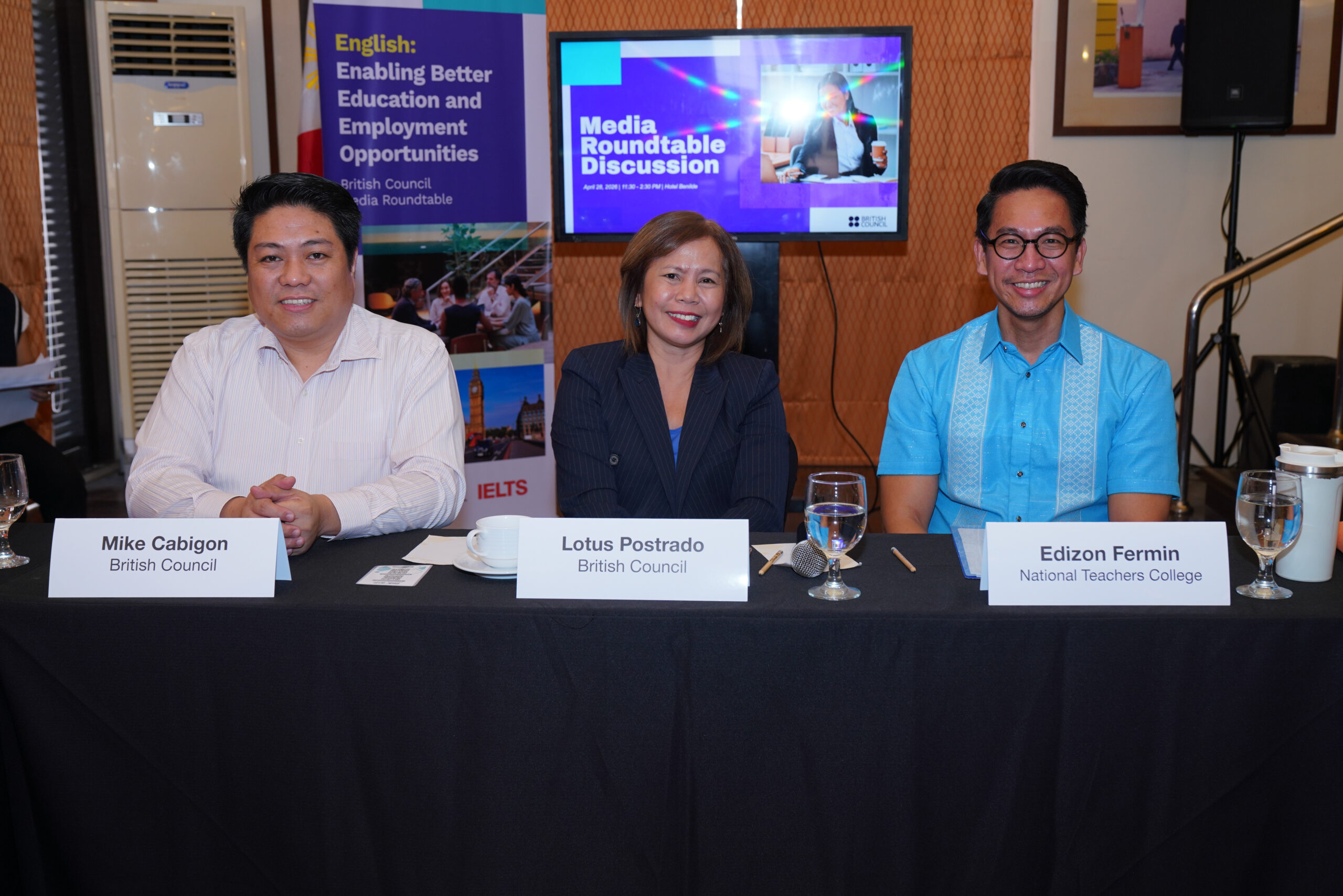
MANILA, Philippines – The British Council recently gathered educators and assessment specialists on 28 April 2026 to address a pressing concern: that gaps in English learning are leaving Filipino learners underprepared for higher education, employment, and international opportunities.
Held in observance of English Day, the roundtable discussion comes amid alarming data: nearly half of Filipino learners are not reading at grade level by Grade 3, and by age 15, 76% fall below minimum reading proficiency — equivalent to a 5.5-year learning deficit, according to the Second Congressional Commission on Education (EDCOM 2) and the Programme for International Student Assessment (PISA).
English as Infrastructure, Not Just a Subject
For panelists, English is no longer just a subject. It is the infrastructure that underpins learning itself, enabling Filipino learners to access knowledge, develop skills, and participate in an increasingly English-speaking global landscape.
“English should be integrated into the learning experience, not isolated from it,” said British Council Country Director Lotus Postrado. “Our role at the British Council is to make this pathway accessible through teaching support, curriculum integration, and learner-focused programmes that build confidence and skills among learners across a wide range of English proficiency levels.”
National Teachers College (NTC) Vice President for Academic Affairs Edizon Fermin echoed this view, noting that English functions as the primary medium of instruction in subjects like mathematics and science, making communicative competence a cross-curricular concern. He cited the English as a Subject in Basic Education (ESBE) study — a partnership among the British Council, the Department of Education, and NTC — as surfacing critical structural gaps in how English is taught and assessed in Philippine schools.
Among the study’s key findings: the curriculum does not follow the natural sequence of language acquisition. Learners are expected to read and write in English before developing sufficient listening and speaking skills, resulting in students who can recognize words but struggle to use them in real-world communication.
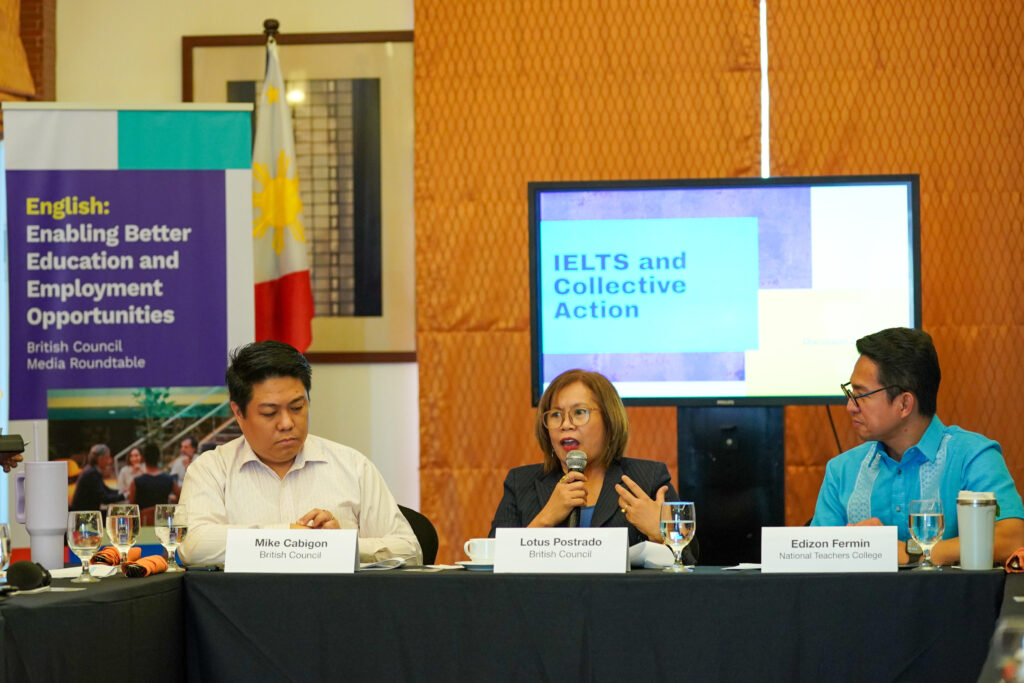
Fermin flagged two compounding problems: textbooks dominated by lower-order tasks with no alignment to recognized vocabulary frameworks, and teachers assessed at the same B2 benchmark set for basic education learners. “The ESBE study revealed this is not just a proficiency problem, but a preparation problem,” he said. “We are working to address this at the pre-service level, embedding qualifications like CELTA (Certificate in English Language Teaching to Adults) into the bachelor’s program through micro-credentials, so global certification becomes part of undergraduate education, not a post-graduation privilege.”
The Economic Cost of Falling Behind
The roundtable also surfaced economic consequences. British Council Head of Exams Mike Cabigon noted that overseas recruitment partners are increasingly looking beyond the Philippines because candidates cannot meet English language requirements — a shift felt acutely in Business Process Outsourcing (BPO) and online English as a Second Language (ESL) teaching, where internationally recognized certification is now standard.
“The Philippines used to be the primary source of English-speaking nurses and skilled workers globally, but that position is now being challenged,” Cabigon said. “Assessments like the International English Language Testing System (IELTS) give Filipino workers a credible way to demonstrate their proficiency, opening doors not just for opportunities abroad, but for growing markets here at home. If we invest in proficiency and pair it with the right benchmarks, the Philippines does not just recover lost ground. It leads.”
Charting a Path Forward
Cabigon also noted that the British Council is working with the Commission on Higher Education (CHED), the Philippine Association of Colleges and Universities Commission on Accreditation (PACUCOA), and other partners to promote the adoption of international English language standards through the use of standardised assessments for students and teachers in higher education. Fermin, meanwhile, pointed to the National English Proficiency Act as the policy foundation needed to anchor these efforts nationally.
Postrado closed by affirming the British Council’s long-term vision: not to center itself in the Philippine education system, but to support government and institutional partners in building a system that can sustain English proficiency improvements on its own — one where English is an opportunity available to all Filipinos, not just a few.
Through its English and education work, the British Council partners with governments and institutions to strengthen teaching, assessment, and curriculum aligned with real-world communication needs, supporting improvements that enhance both academic outcomes and workforce development.