
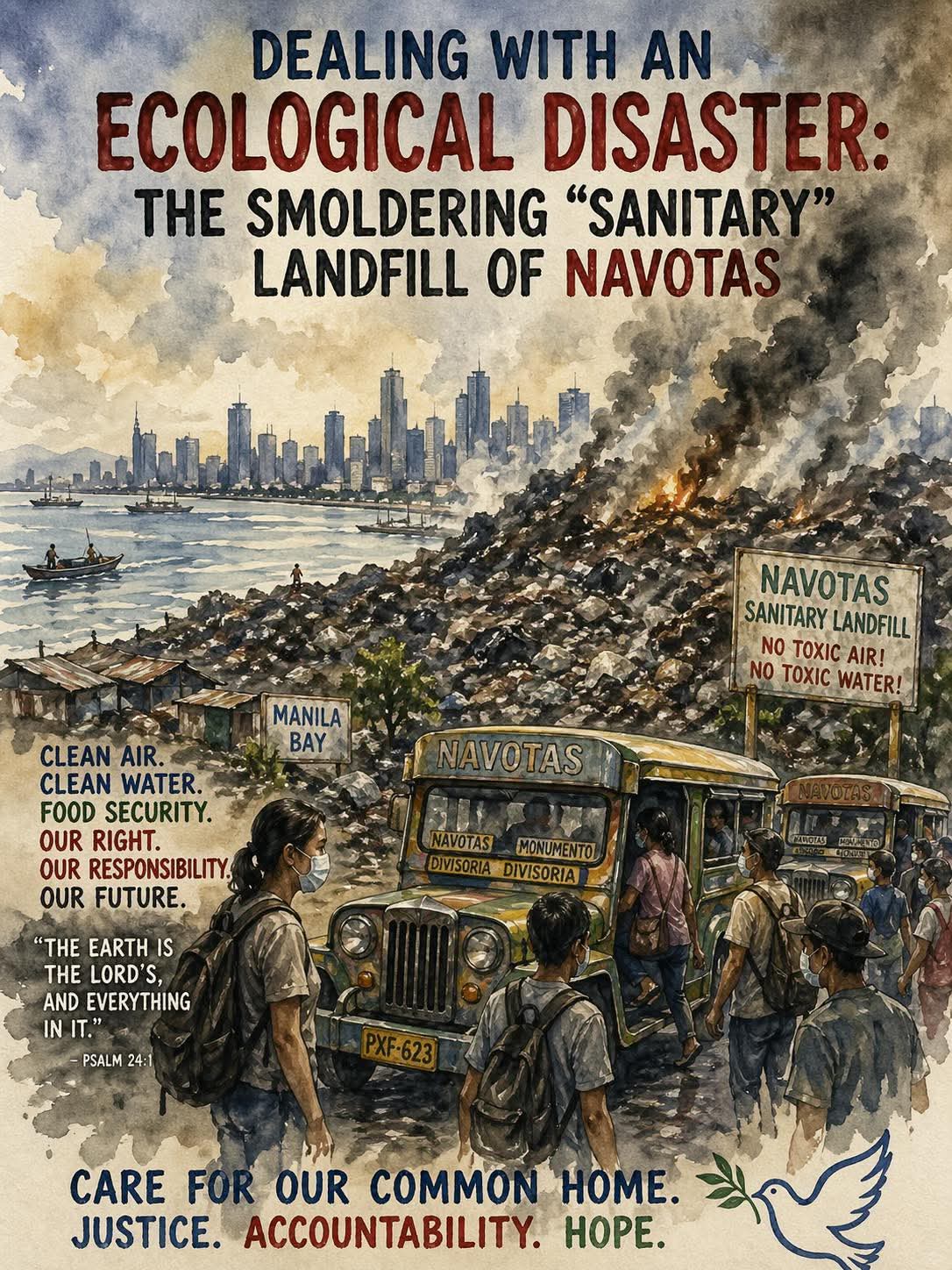
A SANITARY landfill is not a dumpsite. Under Republic Act No. 9003, it must be properly sited, aligned with local land use plans, and built to protect environmentally sensitive areas. The law mandates liners, leachate collection and treatment, gas control systems, groundwater monitoring, and rigorous post-closure care.
That is precisely why the Navotas landfill fire demands more than concern — it demands accountability.
DENR-EMB has announced it is studying criminal, civil, and administrative cases against the former operator, citing an unfinished Safe Closure and Rehabilitation Plan, missing gas ventilation pipes, and a non-functioning water treatment plant. Officials have stated plainly: the fire could have been avoided. And yet here we are. Which raises an equally urgent question — why was an Environmental Compliance Certificate ever issued for a facility that apparently could not meet basic closure standards?
The fire has burned for days. Navotas, Malabon, and Obando have suffered the smoke. The Bureau of Fire Protection has identified ignited methane from decomposing waste — compounded by extreme heat — as a likely cause. No final legal finding has been made, but the evidence already on record raises grave questions about gas control, closure compliance, and who was watching.
This is not an isolated failure. It is part of a pattern.
RA 9003 was never meant to make landfills a permanent solution. The law requires every barangay — or cluster of barangays — to have a Materials Recovery Facility, with each LGU diverting at least 25% of waste through recycling, composting, and reuse. Yet a 2023 Commission on Audit performance audit found that as of 2021, only 16,418 of 42,046 barangays — barely 39% — were actually served by MRFs. The law exists. Compliance does not.
We have seen what happens when we ignore these warnings. The Supreme Court permanently closed the San Mateo landfill after it demonstrably harmed surrounding communities and threatened water sources. This year alone, Cebu’s Binaliw landfill suffered a deadly trash slide, and another major landfill in Rodriguez, Rizal was suspended following a similar disaster. These are not accidents. They are consequences.
So, the harder questions must now be put on the table: Why are landfill projects permitted in low-lying coastal and fishpond areas — places whose ecological value includes aquaculture, food production, and water protection? If a facility threatens air quality, water quality, and the communities around it, can it honestly still be called “sanitary”? The Clean Water Act prohibits allowing pollutants to seep into soil or groundwater. RA 9003 itself bans landfill construction on aquifers, groundwater reservoirs, and watersheds. These are not aspirational guidelines. They are legal prohibitions.
And the law gives you standing.
Under Section 52 of RA 9003, any citizen may file a civil, criminal, or administrative action against violators, negligent officials, or agencies acting inconsistently with the law — after providing 30 days’ notice. The Rules of Procedure for Environmental Cases further allow citizen suits and, in urgent situations, a Temporary Environmental Protection Order.
This is no longer a conversation about garbage management. It is about clean air, clean water, food security, public health, and the constitutional right to a balanced and healthful ecology. When a landfill poisons the air, endangers water sources, displaces aquaculture, and becomes a recurring fire and disaster risk, the public is not just entitled to answers — it is entitled to justice.
Who will join our collective lawsuit?