
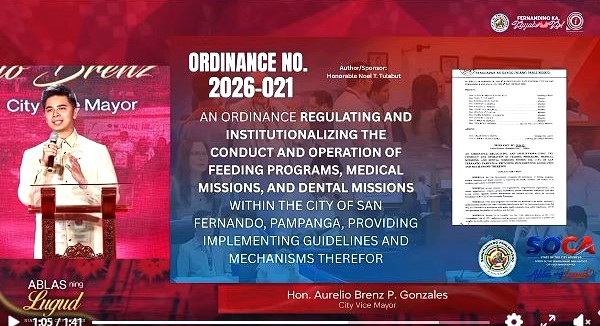
CITY OF SAN FERNANDO – At his turn during the 2026 State of the City Address dubbed “Abalas Ning Lugud” on July 2, Vice Mayor Brenz Gonzales highlighted – among the accomplishments of the 9th Sangguniang Panlungsod – Ordinance No. 2026-021, “An Ordinance Regulating and Institutionalizing the Conduct and Operation of Feeding Programs, Medical Missions, and Dental Missions within the City of San Fernando…” thus:
“Nung ating meging pisasabyan a ordinansa keni king San Fernando, apin nepu ini. Meging very controversial, meging topic daring liwa-liwang debate, meging pistahan dareng trolls king social media pero king perseverance ampong resilience ng Councilor Noel (Tulabut), mipasar ya pa rin pu king second and final reading ining ordinansang ayni. (If there is one ordinance that has caused much discussion in San Fernando, it is this ordinance. It has become controversial, a topic in various debates, feasted on by trolls in social media but through the perseverance and resilience of Councilor Noel, it was passed on its second and final reading).
“The goal of this ordinance is not to stop help, but to organize help.
Feeding programs, medical missions, and dental missions must be safe, coordinated and properly implemented.”
“Hindi po natin pinipigilan ang pagtulong, mas lalo po nating pinapabuti ang pagtulong – upang ito ay maayos, ligtas at tunay na kapaki-pakinabang sa ating mga Fernandinos.”
The Pampanga Sangguniang Panlalawigan on July 1 disapproved the city ordinance deemed as “legally deficient, structurally defective and impractical to implement.”
Among those cited as reasons for the disapproval are:
The ordinance covered only privately funded or privately sponsored activities while exempting government-funded, government-sponsored or government-implemented programs, raising concerns over a possible violation of the equal protection clause of the Constitution;
Several provisions could encroach on national laws and existing regulatory systems governing the practice of medicine, dentistry, food safety and administrative procedures by creating a local authorization process in areas already regulated by national government agencies;
Vague and burdensome requirements for volunteer groups, charitable organizations, schools, faith-based organizations, civil society organizations and other private-sector organizers, that could discourage volunteerism, delay humanitarian assistance and hamper community-based and emergency response activities. Punto News Team/Photo: CSFP-CIO


