

2026 WAS but two days old when US special forces intruded into Venezuela, seized President Nicolas Maduro from his home, and flew him, along with his wife Cilia Flores, to the USA to reportedly face federal narco-terrorism charges in New York.
Brazen as it is and defiant of all international laws, there is nothing new to the Venezuelan experience of American aggression and infringement of its national sovereignty. No, it did not start nor shall it stop with President Donald Trump. As a matter of course, these are de facto instruments of US national policy that is imperialism.
The United States was not even 25 years removed from its declaration of independence when it triumphantly entered its first major international conflict – the Barbary Wars (May 1801 to June 1805 under President Thomas Jefferson; and June 17-19, 1815 with President James Madison) – fought in the Arab World, notably in present-day Algeria, Libya, and Tunisia, over piracy and the demand of exorbitant tributes by the Barbary states.
In its own backyard – or backwaters, as some put it – a mere eight years from the end of that three-day second war, US President James Monroe declared his eponymous doctrine enunciating US primacy in the Western Hemisphere, depriving European powers of any foothold in the Americas.
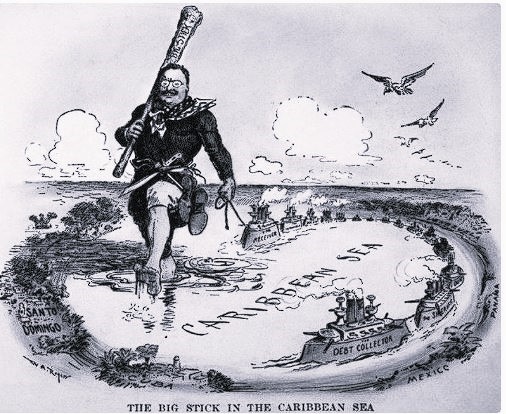
The Monroe Doctrine further hardened in President Theodore Roosevelt’s own self-named Corollary of 1904 asserting the US right to intervene in Latin American affairs to prevent any European inroads “to ensure stability, financial responsibility, and order” in the Western Hemisphere, thereby justifying American interventionism in the region, even sans any trans-Atlantic threat.
Eighty-one years apart and over two centuries since, both articles of American hegemony have since provided the “justness” of “righteous” intrusions in central and south American national affairs.
Cold War
In 1961, with the imprimatur of President John F. Kennedy, the Bay of Pigs Invasion was launched and as instantly failed in its objective of ousting communist Fidel Castro from Cuba.
In 1965, 20,000 US troops were sent by President Lyndon B. Johnson to the Dominican Republic to prevent the return of former President Juan Bosch who was overthrown in a US-backed coup in 1963, and avert the establishment of another communist regime in the Americas.
While direct involvement of the US government under President Richard M. Nixon was not expressly established in the bloody 1973 coup that did not only oust from office but terminated with extreme prejudice democratically elected devoted Marxist President Salvador Allende, it was stated fact that the CIA was at the spearhead of destabilization and covert operations that fostered the “coup climate” leading to the regime change that ushered in the dictatorship of Gen. Augusto Pinochet.
Under President Ronald Reagan, CIA destabilization in Nicaragua in the 1980s aimed at overthrowing the Sandinista regime through covert operations, psychological warfare, and direct funding, training, and arming right-wing Contra rebels culminated in the Iran-Contra Affair – the illegal sale of arms to Iran in exchange for cash to be sent to anti-Sandinista forces.
In 1983, President Reagan ordered the invasion of Grenada in the wake of the overthrow and execution of Prime Minister Maurice Bishop, citing the protection of US medical students in the Caribbean island nation and preventing it from becoming a communist “Soviet-Cuban colony.”
In the span of over twenty years from Kennedy to Reagan, the US raised the communist bogey as sole casus belli in its political-military intervention in the Americas.
Close to the end of the Cold War, with the fall of the Berlin Wall on Nov. 9, 1989,
a new cause of war evolved with President George H.W. Bush (the elder of the two Bushes) ordering the invasion of Panama in mid-December 1989, to depose de facto dictator Gen. Manuel Noriega who was criminally charged in the US for racketeering, drug trafficking, and money laundering. Surrendering in January 1990, Noriega was flown in shackles to the USA and subsequently tried, convicted, and imprisoned.
Déjà vu. Maduro’s case hews uncannily all too closely with Noriega’s.
Manifest destiny
Even at its onset, US imperialist adventurism has pushed and shoved beyond its geopolitical locus that is the Western Hemisphere.
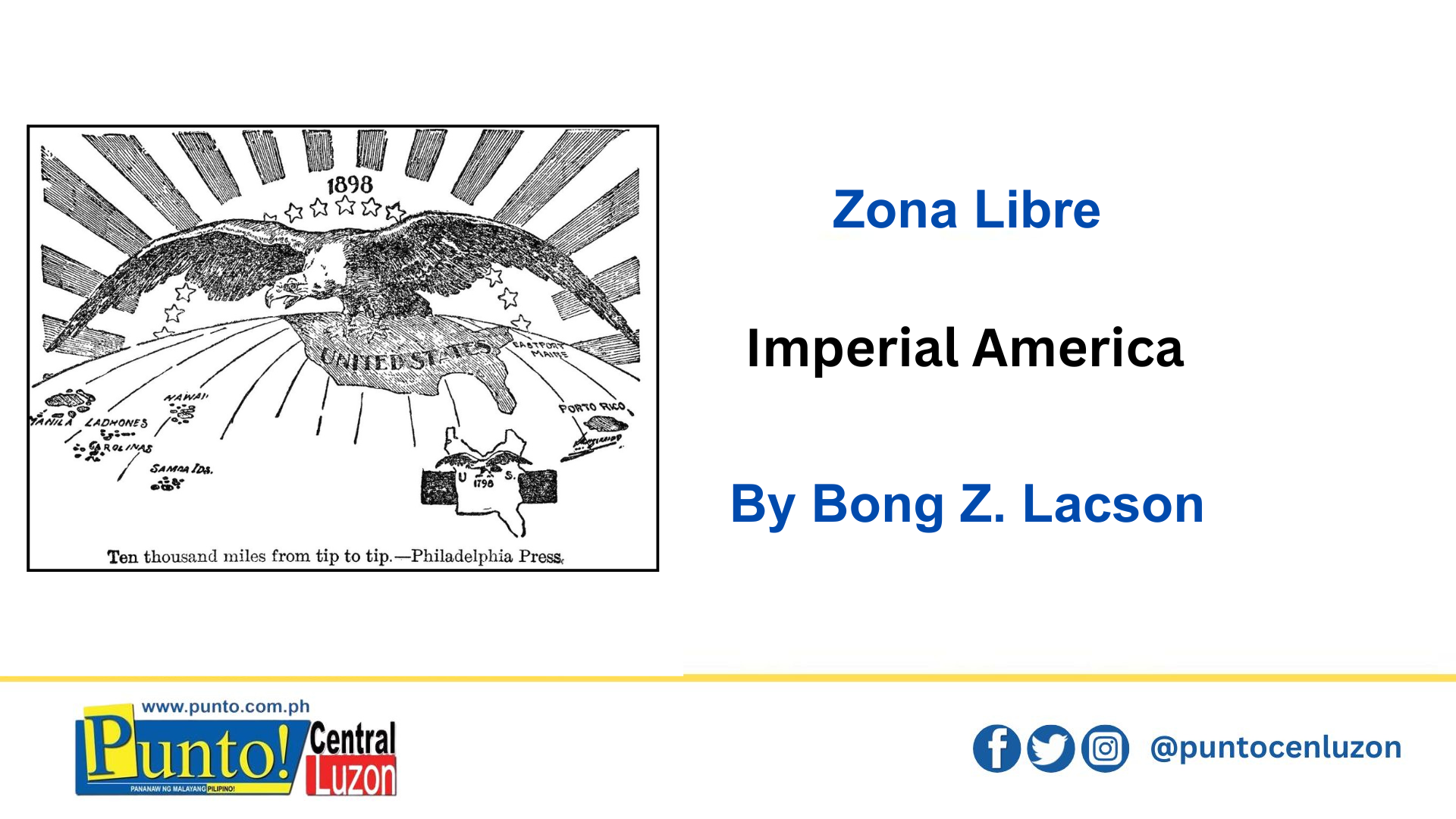
Remember the Maine? The US Navy ship that mysteriously exploded and sank in Havana Harbor along with over 200 crewmen in February 1898, providing fodder to sensational journalism that precipitated the Spanish-American War ending with the US’ annexation of Puerto Rico, Hawaii, Guam, American Samoa, and the Philippine Islands.
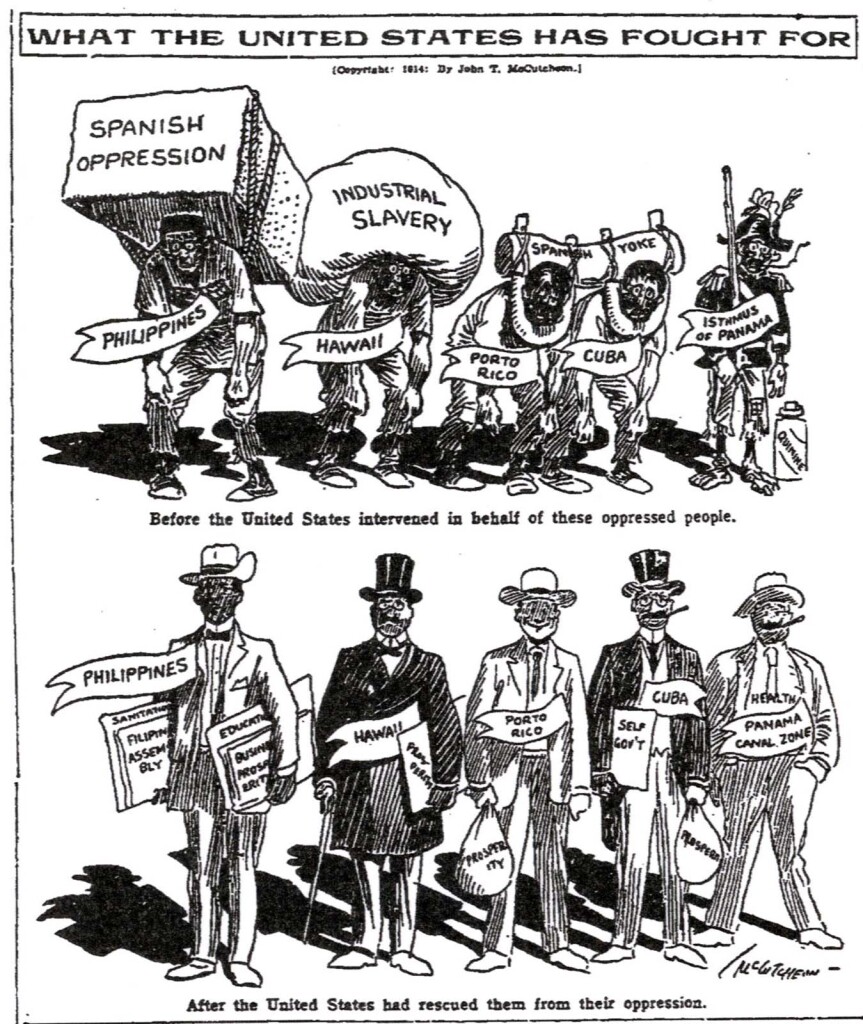
Of the US “benevolent assimilation” of the Philippines, President William McKinley bore witness, as it were: “… I went down on my knees and prayed Almighty God for light and guidance more than one night. And one night late it came to me this way—I don’t know how it was, but it came: (1) That we could not give them back to Spain—that would be cowardly and dishonorable; (2) that we could not turn them over to France and Germany—our commercial rivals in the Orient—that would be bad business and discreditable; (3) that we could not leave them to themselves—they were unfit for self-government—and they would soon have anarchy and misrule over there worse than Spain’s was; and (4) that there was nothing left for us to do but to take them all, and to educate the Filipinos, and uplift and civilize and Christianize them, and by God’s grace do the very best we could by them, as our fellow-men for whom Christ also died…”
Thus, Manifest Destiny defined, in the fulness of its three basic tenets – per historian William Earl Weeks – “1) The assumption of the unique moral virtue of the United States; 2) The assertion of its mission to redeem the world by the spread of republican government and more generally the ‘American way of life’; and 3) The faith in the nation’s divinely ordained destiny to succeed in this mission.”
Whatever the declared rationale in the US military engagements across nations, most notably in WWI under President Woodrow Wilson and WWII under President Franklin D. Roosevelt, the underlying cause remains attributable to its Manifest Destiny.
Thus, President Harry Truman engaging the US in the Korean War in the early ‘50s to defend the “Free World” against communism.
Hence, America in Vietnam in the ‘60s to the ‘70s from President Dwight Eisenhower to Kennedy, Johnson, and Nixon – lest its fall to godless communism leads to a domino effect in all of Southeast Asia.
On the initiative of President GHW Bush, Kuwait was invaded by a US-led coalition in the early 1990s to liberate it from the despot Saddam Hussein.
Under President Bill Clinton, the US engaged in the Bosnian War of 1992-1995 initially with extensive aviation sorties and finally brokering the peace negotiations in Dayton, Ohio that ended it.
The 2001 US invasion of Afghanistan under President George W. Bush (the younger) started as punitive action in the wake of 9/11 against al-Qaeda and to overthrow the Taliban, turned into a 20-year war of counter-terrorism while propping up an interim power-sharing government – through the presidencies of Barack Obama and Donald Trump, and ended under President Joe Biden in a hasty withdrawal – ala Vietnam – in 2021 with the Taliban retaking power.
Instigated by horrific images of weapons of mass destructions and al-Qaeda fears, Bush the Younger initiated the Iraq War in 2003 under another US-led coalition that finally overthrew and executed Saddam and installed an Iraqi government along republican lines but was immediately beset by an insurgency even after the withdrawal of US forces in 2011 under Obama.
It was under Obama too that US forces re-engaged in the conflict with the ISIS in Iraq in 2014.
No invasion but intrusion into Pakistan of US Navy SEAL Team 6 on May 2, 2011, to kill al-Qaeda founder Osama bin Laden in his hideout in Abbottabad, culminating the decade-long hunt for the 9/11 mastermind. Obama famously watching the actual operation in real time.
All the presidents but one
Jefferson. Madison. Monroe. McKinley. Roosevelt. Wilson. Roosevelt. Truman. Eisenhower. Kennedy. Johnson. Nixon. Bush Senior. Clinton. Bush Junior. Obama. Trump. Biden. Trump.
Destined or not but definitely most manifest, all these presidents – and definitely even the others – had had their own take of military adventurism on a global scale. Nonetheless, the presidents were no more than mere implements in the great scheme of things: America is in and of itself the very embodiment of imperialism.
“America… goes not abroad, in search of monsters to destroy. She is the well-wisher to the freedom and independence of all.”
How John Quincy Adams, the 6th US president, must be rolling over in his grave.