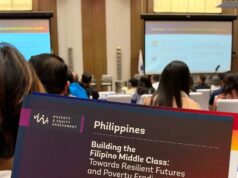

AT THE World Bank Forum, “Building the Filipino Middle Class: Toward Resilient Futures and Poverty Eradication,” the Pampanga Business Circle (PBC) raised an important economic policy question before the World Bank presenters:
Is it time for the Philippines to consider a government-supported, transitional wage subsidy program that will enable low-income Filipino workers to earn a decent living without placing the entire burden of wage increases on employers, particularly micro, small, and medium enterprises (MSMEs)?
PBC proposes exploring a three-to-five-year transitional wage subsidy program, under which the government would shoulder 80% of the approved wage increase while employers would contribute the remaining 20%. The government subsidy would gradually decline as businesses adjust, productivity improves, and enterprises become capable of sustaining higher wages independently.
The objective is not simply to increase wages but to create a sustainable economic cycle in which workers earn more, businesses grow, employment expands, and the government benefits from stronger economic activity.
Empowering Workers to Strengthen the Economy
PBC believes that improving the purchasing power of millions of low-income Filipino earners can become a powerful driver of domestic economic growth. When workers have sufficient income to provide for their families, they spend more on food, housing, transportation, education, healthcare, and other necessities. This additional consumer demand can generate higher sales for businesses, encourage investments, expand production, and create employment opportunities.
Rather than relying exclusively on long-term poverty alleviation programs, a properly implemented wage subsidy could provide immediate and measurable financial relief to qualified workers.
This proposal is consistent with the aspirations of AmBisyon Natin 2040, which envisions a predominantly middle-class Filipino society enjoying stable, comfortable, and secure lives.
Managing Inflation and Protecting MSMEs
PBC recognizes that wage increases, if poorly designed, could create inflationary pressures, wage distortions, financial burdens on employers, and opportunities for fraudulent claims.
However, a properly structured government subsidy could substantially reduce the immediate labor-cost pressures that might otherwise force businesses to increase their selling prices, reduce employment, or cease operations.
The program could therefore help moderate cost-push inflation while strengthening purchasing power. Its actual effect on overall inflation would depend on productivity, domestic supply, fiscal financing, and the economy’s capacity to meet increased demand.
Protecting MSMEs must be a central feature of the program. These enterprises are among the most vulnerable to sudden wage adjustments, yet they provide essential employment and economic opportunities throughout the country.
The subsidy must be designed to help MSMEs survive, adjust, modernize, and eventually sustain decent wages without permanent government assistance.
Welcoming DepDev’s Alternative Approach
PBC welcomes the position expressed by the Department of Economy, Planning, and Development (DepDev) that the proposal merits further study, including the possibility of government assistance through employee transportation, food, healthcare, and other essential living expenses.
We consider these alternatives constructive and worthy of serious consideration. What matters most is that government assistance directly improves workers’ disposable income while allowing businesses sufficient time to adjust to higher labor costs.
Whether implemented through direct wage subsidies, targeted employee benefits, or a combination of both, the program must be transparent, fiscally sustainable, properly targeted, and protected against abuse.
A Call for Immediate but Responsible Action
PBC believes that poverty reduction must be pursued not only through infrastructure development, investments, and social assistance programs but also through policies that directly improve the earning capacity of Filipino workers. Many government development programs take years before their benefits reach ordinary families. Meanwhile, rising living costs continue to erode the value of wages.
A well-designed wage subsidy could provide qualified workers with more immediate relief while supporting a gradual transition toward productivity-based, sustainable compensation.
We therefore encourage the World Bank, DepDev, the Department of Labor and Employment, the Department of Finance, employers, workers’ organizations, and MSME representatives to jointly undertake a comprehensive feasibility study and develop an appropriate implementation framework.
The challenge is to balance three equally important objectives: decent wages for workers, sustainable operations for businesses, and fiscal responsibility for government.
The ultimate measure of economic progress should not be GDP growth alone, but whether Filipino workers and their families are genuinely moving out of poverty and into the middle class.
A stronger Filipino middle class means a stronger domestic market, more resilient businesses, and a more inclusive Philippine economy.