
CARLOS P. Romulo wrote, in 1941: “I am a Filipino — inheritor of a glorious past, hostage to the uncertain future.” He chose those words carefully. The word I want to focus on is hostage.
It is good to be here in New Clark City.
For years, American firms have come to Asia in search of speed and scale. They found both, and the bedrock of the modern AI economy was built on that bargain. But the bargain has changed: today’s status quo supply chains have become predictably unreliable. American firms are now grappling with a need they were not forced to weigh a decade ago — the need for predictability, reliability, and certainty alongside the speed and scale that brought them to this region in the first place.
When people hear the words AI supply chain, they think of computer chips. But the chips are only the tip of a very long tail. The chain runs on thousands of inputs. It runs on the precision motors, rare-earth magnets, packaging and testing that turns a slice of silicon into something a buyer can plug in, moldings, plastics, and so much more.
For each of those parts, our position today is unacceptably overconcentrated.
This is not a theoretical point. American firms are losing weeks of production to customs delays that nobody will explain. Orders placed in good faith are cancelled, and no reason is given. A single notice from an office in a far-away capital can shut down a metal the whole industry depends on. We have watched it happen — with rare earths, with gallium, with germanium, with graphite. Rules invented on a Friday and enforced on a Monday. That is not the behavior of a market.
When ninety percent of a critical input comes from one country, you do not have a supply chain. You have a hostage chain.
And the timing could hardly be worse. The build-out of artificial intelligence is creating a surge in demand at every level of the chain — chips, of course, but also metals, magnets, motors, packaging, test capacity, actuators, energy, etc. Growth on that scale requires certainty of supply. The present arrangement is already failing today. And it is entirely ill-equipped for the future bearing down on us.
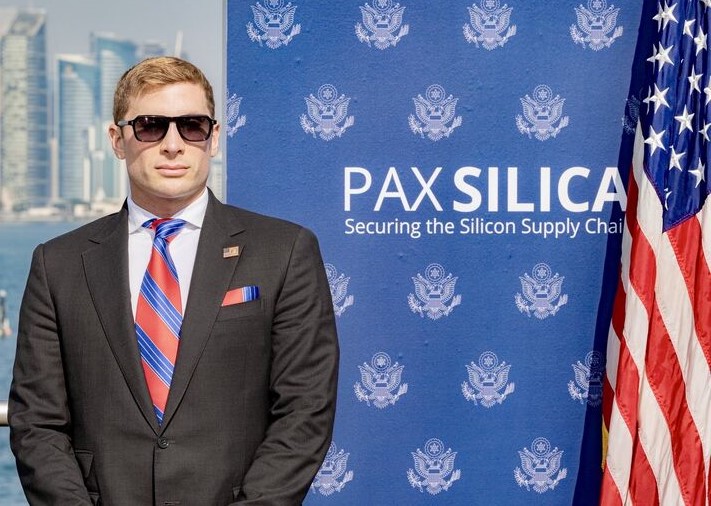
As President Trump’s National Security Strategy makes clear, securing our supply chains is a strategic priority of the Trump administration and is a centerpiece of the State Department’s Pax Silica initiative.
We are committed to pursuing this objective in our own distinctly American way, which will be sharply different than China’s Belt and Road Initiative.
The latter focused on state-built roads. State-built bridges. State-built ports. State suppliers. State operators. State-run banks. The whole machine runs out of a single office. And that is China’s way. It is not ours.
America does not do well when it tries to compete on someone else’s terms by imitating a competitor tit for tat. The American way is to win by building something entirely new.
We are the most inventive country on earth because of our founders, our entrepreneurs, and our companies. The products we build enchant and delight billions of users and unlock new markets that didn’t exist the year before. That is our unique strength, and we will outcompete others by leaning into it.
In January, I said the State Department would treat economic security as a product to be built, not a policy to be announced. Today, on this piece of ground, we are here to see the first such product come into being — a partnership of a kind that has not been tried before, between the United States and its oldest ally in Asia, the Philippines.
This is the site of a planned Economic Security Zone to fuse together the predictability and certainty of American law to the speed and scale of Asia.
Predictability, speed, and scale, in one place. That is the product.
I want to extend a heartfelt thank you to our Filipino friends for their partnership on this bold effort. Thank you to the firms who are considering to build here. And thank you to the Filipinos and Americans whose work will turn a sentence on a page into broken ground.
Romulo’s countrymen, and ours, need not remain hostage to an uncertain future. We will build our way out of it. And that is what we are doing here. Thank you.
(Prepared remarks of the Undersecretary of State on his visit to the Planned Economic Security Zone, New Clark City, 18 May 2026. File phot: Office of the Under Secretary of State for Economic Affairs)